On this page6 sections
Once the power is arranged, the next question is what the machines sit inside. Operators tend to arrive with an answer already formed, usually the one they saw on a site tour, and the three routes suit genuinely different situations. The variables that decide it are how fast you need to be running, how long you expect to stay, and whether the site is yours.
Containers
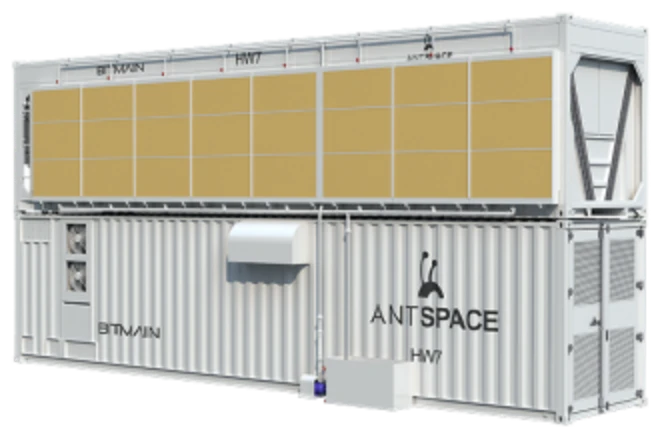
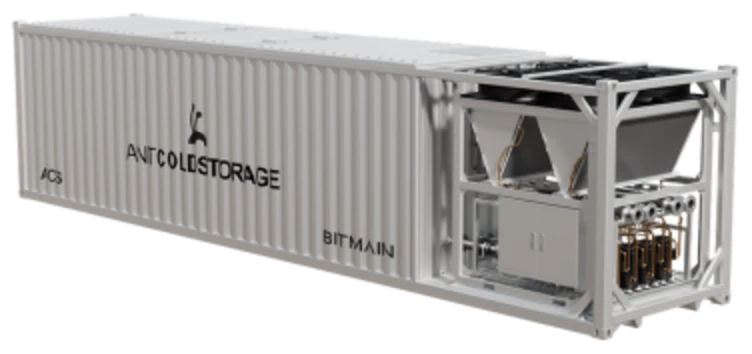
A mining container is an enclosure built for the purpose, typically twenty or forty feet, fitted with airflow or a hydro loop, PDUs and controls. You place it on a pad, connect power and network, and you are running.
The case for it is speed and portability. Lead times are measured in weeks rather than quarters, site preparation is a concrete pad and a transformer, and if your power deal ends you can move the whole thing rather than abandoning it. For anyone mining behind a gas wellhead, at a curtailable industrial site or on land they do not own, this is usually the right answer and often the only one.
The costs are real. Cost per megawatt is generally higher than a good warehouse at scale, density per unit of land is lower, and working inside one in high summer is unpleasant, which quietly affects how promptly maintenance actually happens.
A warehouse built for mining
Building for the purpose gives the lowest cost per megawatt at scale and the best working conditions. Airflow can be designed rather than accommodated, hot and cold separation is built in, cable runs are short and sensible, and technicians can work comfortably, which shows up in uptime.
It is also the slowest and least reversible route. Permits, construction and utility interconnection stack up, and a year from decision to first hash is normal rather than pessimistic. It makes sense when you own or hold a long lease on the land, have a power contract measured in years, and are building at a scale where the saving per megawatt actually pays for the build.
Retrofitting an existing building
The middle route, and the one most first sites take: an existing warehouse, barn, mill or industrial shed, adapted. It can be excellent value when the building happens to suit, and expensive when it does not.
What makes a building suitable is mostly boring: enough incoming power or a realistic path to it, ceiling height for hot air to separate from cold, wall area for intake and exhaust openings, a floor that takes the load, and neighbours far enough away. What makes a building unsuitable is usually the same list in reverse, and the fatal one is almost always power. A perfect shed with a 100 amp single phase supply is not a mining site, it is a shed.
Comparing them on the numbers that matter
- Cost per megawatt installed. Warehouse lowest at scale, retrofit variable, container highest per unit but with the lowest entry cost.
- Time to energisation. Container fastest, retrofit next, new build slowest by a wide margin.
- Reversibility. A container can be sold or relocated. A retrofit is mostly stranded. A new build is a property asset, which is different again.
- Working conditions. This is not a soft factor. Sites that are miserable to work in get maintained late, and late maintenance is downtime.
- Cooling route. Hydro and immersion change the building requirement substantially. See air, hydro or immersion before fixing the building plan.
Noise, and the neighbours
Air cooled machines at scale are loud, in a broadband way that carries further than the decibel figure suggests. This is the most common reason a site gets shut down after it is already running, and it is almost never in the original budget. Hydro and immersion are dramatically quieter, which is sometimes the entire reason to choose them. If there is a residence within a few hundred metres, measure the background sound level before you commit, and treat the result as a hard constraint rather than something to solve later.
The decision in one paragraph
Short power deal, land you do not own, need to be running this quarter: container. Long contract, land you control, scale above a few megawatts and patience: build. Anything in between, and especially a first site: find a building that already has the power, and adapt it. If none of the three is comfortable, that is a strong argument for hosting instead, which we set out in hosting or your own site.
Run this against your own numbers
Tell us your power situation, your site and the scale you are aiming at. We come back with a hardware shortlist and a firm quote.